
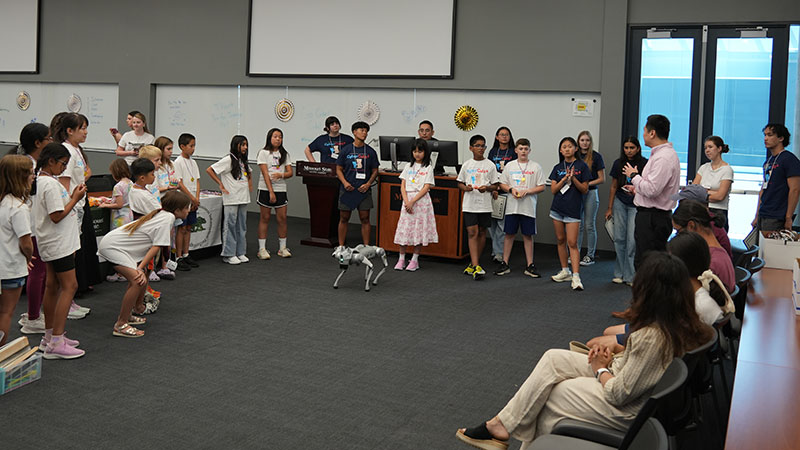
What began as a small summer outreach effort in summer 2024 is growing into a larger investment in Southwest Missouri’s next generation of technology talent.
Missouri State University’s department of information technology and cybersecurity (ITC) has received an $89,868.98 GenCyber grant to expand cybersecurity education and outreach for middle and high school students.
The grant is awarded through GenCyber, a National Security Agency (NSA)-supported initiative that promotes cybersecurity education and helps inspire the next generation of cybersecurity professionals.
Dr. Xiang Guo, head of ITC, serves as program director and principal investigator for the project. Dr. Zhiguo Yang, professor of ITC, is the lead instructor and co-investigator, with co-investigators Jason Speer, senior instructor, and Conner Wilkinson, instructor.
The award will support a new GenCyber summer camp on campus planned for Aug. 16-20, 2027. The camp will allow up to 30 students to gain hands-on experience with cybersecurity, artificial intelligence and robotics while reducing financial barriers to participation. Grant funding will support equipment, supplies, faculty instruction and student counselors.
“We want to help our community and the next generation be technology ready,” said Yang. “When high school and middle school students get early exposure to advanced robotics and AI technology, they have an opportunity to understand these technologies, discover their interests and explore career paths they may not have considered before.”
Where it began
The GenCyber award is the latest step in a cybersecurity outreach effort years in the making at Missouri State.
ITC first gained experience working with younger learners through Cyber Cubs. Over three summers, faculty and student counselors developed lessons, tested hands-on activities and learned how to introduce cybersecurity, coding and robotics to students with varying levels of technology experience.
The work provided more than a successful summer camp. It gave the department a tested curriculum, lesson plans, photos, testimonials and a proven ability to deliver cybersecurity education to young learners.
At the same time, ITC strengthened its academic cybersecurity infrastructure. Missouri State established its Center of Academic Excellence in Cybersecurity Operations, Research and Engagement and earned the National Security Agency’s Center of Academic Excellence in Cyber Defense (CAE-CD) designation in 2025. The designation recognizes institutions that meet national standards for cybersecurity education, with community outreach forming part of the broader mission of the CAE-CD program.
Those initiatives led to the next step: GenCyber, a program available only to academic institutions with a current CAE-CD designation.
“These milestones were not separate accomplishments, but part of a deliberate progression,” said Guo. “Each step builds a stronger foundation for what comes next, but the goal has always been bigger than the program itself. It’s about using what we’ve built to give back to the community and create more opportunities for the next generation.”
Putting GenCyber in motion
The new camp will move students from learning cybersecurity concepts to applying them to systems they can build, test and see in action.
Students will explore defense-in-depth; confidentiality, integrity and availability; adversarial thinking; and secure system design. They will reinforce those concepts through applying them with physical computing and robotics challenges.
One planned project brings several of those ideas together in an autonomous or semi-autonomous building patrol security system. Student teams will work with a quadruped, design patrol routes and explore how cameras can identify potential physical security concerns. They will also examine how the system could detect suspicious Wi-Fi access points.
Programming experience is preferred but not required for the GenCyber Camp. Rather than making coding a barrier, the curriculum teaches students to think through logic, system design and how different technologies work together to solve security problems.
“We want campers to focus on the design, figuring out what their program needs to do to solve the problem,” Yang said.
How to participate
Registration details for the 2027 GenCyber Camp will be announced when available. Students and families across Missouri interested in the program can visit the Association for Business Information Students website.
Explore information technology and cybersecurity
Discover more from News
Subscribe to get the latest posts sent to your email.