
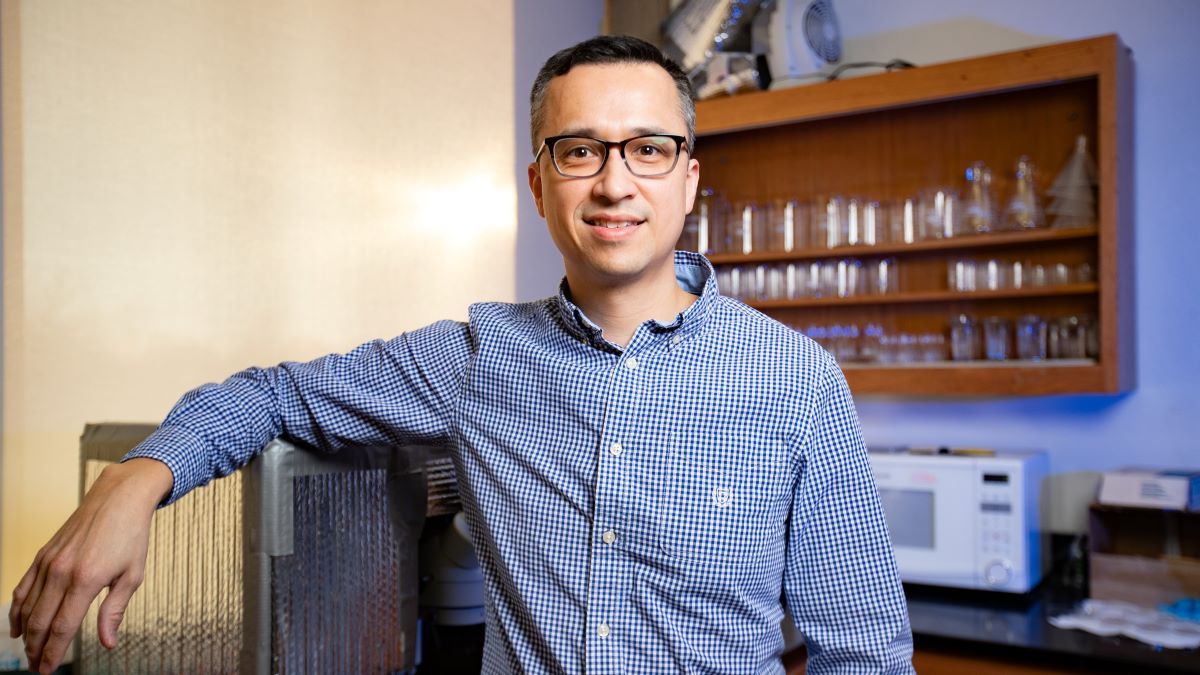
Dr. Ryan Udan’s cardiovascular research could help save thousands of lives.
The associate professor of biology at Missouri State University works toward a solution to congenital heart disease and vascular conditions.
Udan’s efforts are supported by an AREA grant from the National Heart, Lung and Blood Institute.
His central question is simple: How does the cardiovascular system form to begin with?
“If we understand the rules of how to build a blood vessel,” Udan said, “we could repair or even build vessels outside of the body.”

The core of his cardiovascular research
Researchers don’t know everything about how the cardiovascular system develops in humans.
That’s why Udan and his team of student researchers are experimenting with embryos from several organisms, including zebrafish and mice.
Drugs and substances can change the cardiovascular development of a mouse embryo, which provides useful information that translates to human beings.
The core interest of Udan’s team: How do blood vessels close to the heart accommodate more blood flow than capillaries farther away?
First, vessels closer to the heart must get bigger in size.
“They actually somehow magically come together and form a bigger vessel,” Udan said.
A good metaphor for great science
Udan knows that blood flow creates a mechanical force to tell certain vessels to get bigger and to form a thicker tissue.
He compares the process to using a garden hose.
“When you turn on a hose, there’s pressure,” he said. “If you turn on the nozzle, water flows because there’s friction from the water against the wall of the hose.
“The same thing happens with these blood vessels. They get this mechanical force. That force turns on the genes, so they change themselves.”
Discover more from News
Subscribe to get the latest posts sent to your email.